Carbon Monoxide Detectors: Where to Put Them and How Often to Test
Carbon monoxide is colorless and odorless, so a working alarm is your only warning. Learn where to place CO detectors on every level, spots to avoid, monthly testing, and when to replace them.
Carbon monoxide (CO) is a colorless, odorless gas produced when fuel burns, so a working carbon monoxide alarm is the only reliable way to know it is building up in your home. The Centers for Disease Control and Prevention (CDC) reports that every year more than 400 Americans die from unintentional CO poisoning not linked to fires, more than 100,000 visit an emergency department, and more than 14,000 are hospitalized.
Any home with a gas furnace or boiler, water heater, stove, dryer, fireplace, wood stove, or attached garage has a possible source of CO. This guide covers carbon monoxide detector placement room by room, where not to put one, how often to test it, and when to replace it.
Carbon monoxide detector placement: where to put CO alarms
Proper placement matters as much as owning the alarm. The CPSC, NFPA, and EPA agree on the basics:
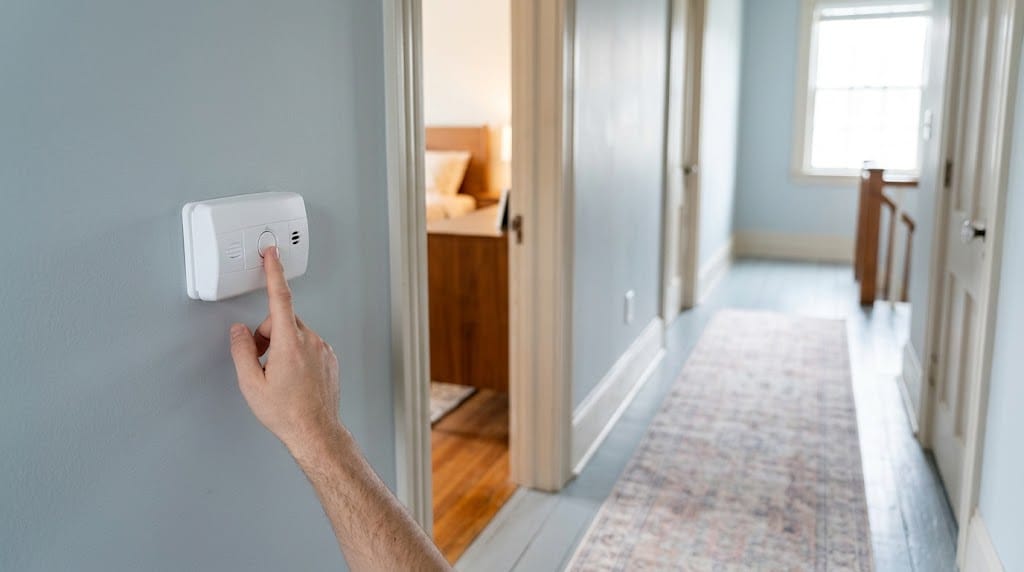
- Outside each sleeping area. Put a carbon monoxide alarm in the hallway outside bedrooms, in a central spot where it is loud enough to wake everyone. If bedrooms are spread across different parts of the house, each sleeping area needs its own alarm.
- On every floor of the home. The EPA says each floor needs a separate detector. That includes a finished attic or a basement with a bedroom.
- Anywhere your state or local code requires one. NFPA notes that laws and codes can add locations, and requirements can vary by state and city, so check your local rules.
If you are buying just one alarm, the EPA says to put it near the sleeping areas and make sure it is loud enough to wake you.
Basements and attics
The CPSC says CO alarms should not be installed in attics or basements unless they include a sleeping area. Some alarm makers, such as First Alert, suggest also placing one in a basement that holds a furnace or water heater. If you add a basement alarm, it is in addition to the ones outside sleeping areas, not a replacement.
Attached garages
Do not put the alarm inside the garage. Car exhaust and temperature swings there can cause false alarms. First Alert recommends placing one inside the home near the door that leads from the garage.
Does height matter?
Not much. You may read that carbon monoxide is lighter than air, so the detector must go high on the wall, or that it is heavier than air, so it must go low. First Alert explains that CO mixes with the air in a room, so the alarm does not need to be near the floor or the ceiling. First Alert says to follow the mounting instructions for your model. Many alarms can go on a wall, on a ceiling, or plug into an outlet. Pick a spot where you can reach it for testing and where you will hear it from the bedrooms.
Where not to put a carbon monoxide detector
Bad placement causes nuisance alarms or slow detection. To avoid false alarms, manufacturer guidance from First Alert lists these spots to skip:
- Directly next to a furnace, water heater, or fireplace. Kidde recommends that any additional alarms near CO sources go about 5 to 20 feet from appliances like these.
- Inside a garage
- Bathrooms and other humid areas
- Dead-air spots such as tight corners or behind furniture and curtains
- Directly in front of heating or cooling vents or ceiling fans
- Areas with heavy dust, grease, or chemical fumes
- Right next to a window or door, which Kidde also lists as a spot to avoid
Kidde's rule of thumb is to choose a location free of obstructions, where the alarm will stay clean.
Placement examples by floor plan
| Home type | Minimum CO alarm placement |
|---|---|
| Single-story house | One in the hallway outside the bedrooms; add more if bedrooms are in separate wings or living areas are far away |
| Two-story house | One on each floor, including one outside the bedrooms |
| House with basement | One outside sleeping areas on each level with bedrooms, one on the main floor, and consider one in a basement with fuel-burning appliances |
| Apartment or condo | One outside the sleeping area; one per level in a multilevel unit |
These examples follow CPSC guidance and First Alert's placement guide. Renters should check their lease and local law, which may spell out who installs and maintains CO alarms.
Choosing a CO alarm
- Look for UL 2034 certification. The EPA recommends alarms certified to the current Underwriters Laboratories (UL) 2034 standard (or IAS 6-96).
- Battery or battery backup. The CPSC recommends alarms that are battery operated or have battery backup, so they work during a power outage, which is exactly when people run generators and fuel-burning heaters.
- Interconnected alarms are best. The CPSC and NFPA both recommend interconnecting alarms so when one sounds, they all sound. Wireless interconnected models are available for homes without hardwiring.
- Combination smoke detector and carbon monoxide alarm units are available and save ceiling space. The CPSC notes smoke alarms belong on every level and inside each bedroom as well.
- A digital display that shows the CO level can help you and responders understand what happened, though it is not required.
How often to test carbon monoxide detectors
Test every carbon monoxide alarm once a month. The CPSC and NFPA both recommend monthly testing. To test the detector, press and hold the test button until the alarm sounds. If nothing happens, replace the batteries and test again. If it still fails, replace the alarm.
For batteries, the CPSC recommends replacing them every year, or using alarms with sealed 10-year batteries. The CDC suggests checking or replacing batteries when you change your clocks in spring and fall, which makes the date easy to remember. Our daylight saving time home maintenance checklist pairs alarm checks with other twice-a-year jobs.
Keep alarms clean, too. Dust can block the sensor openings. Follow the manufacturer's cleaning directions, which usually call for a gentle vacuum with a soft brush attachment.
When to replace a CO detector
CO sensors wear out. The CDC says to replace your CO detector following the manufacturer's instructions or every 5 years. Many newer alarms are rated for longer: BRK, which makes First Alert alarms, says most of its current CO and combination alarms have a 10-year life.
According to BRK, the UL 2034 standard has required CO alarms made on or after August 1, 2009 to include an end-of-life signal, a chirp pattern different from the alarm sound that tells you the unit needs replacing. Check the manufacture date on the back of each alarm. If it is older than the manufacturer's rated life, or you cannot find a date, replace it.
What to do if the CO alarm goes off
- Get everyone out to a fresh air location right away, including pets. NFPA says to move outdoors or to an open window or door.
- Make sure everyone is accounted for.
- Call 911 from outside or from the fresh-air location.
- Stay out until emergency responders say it is safe to go back in.
- Have the source found and fixed by a qualified technician before using the appliance again.
Never ignore a CO alarm or assume it is a false alarm. The CPSC is direct about it: never ignore an alarming CO alarm.
Symptoms to know
The CDC describes common CO poisoning symptoms as headache, dizziness, weakness, upset stomach, vomiting, chest pain, and confusion, often described as flu-like. People who are asleep or drunk can die before they have symptoms. If anyone in the home has these symptoms, especially several people at once or symptoms that ease when they leave the house, get to fresh air and call 911.
Prevent CO at the source
The EPA calls CO alarms a backup, not a replacement, for proper installation and maintenance of fuel-burning appliances. The CDC and CPSC recommend:
- Have your furnace or boiler, water heater, and other gas, oil, or coal appliances serviced by a qualified technician every year, including a check that the flue and venting are clear.
- Never run a generator inside the home, basement, or garage, even with doors and windows open. Keep it at least 20 feet from windows, doors, and vents.
- Never use a gas oven or stove to heat your home.
- Never burn charcoal indoors.
- Do not leave a car running in an attached garage, even with the garage door open.
- After a snowstorm, clear snow from furnace, dryer, and fireplace vents, as NFPA advises.
Power outages are one of the most common times for CO poisoning because of generator and heater misuse. See our guide to preparing your home for a power outage for safe generator setup, and our home fire safety tips for smoke alarm placement.
FAQ
How many carbon monoxide detectors do I need?
At minimum, one on every level of your home and one outside each separate sleeping area, per CPSC and NFPA guidance. A two-story house with all bedrooms upstairs typically needs at least two.
Should a carbon monoxide detector be high or low on the wall?
Height matters less than location because CO mixes with room air. Follow your alarm's mounting instructions, keep it out of dead-air corners, and make sure it can be heard from the bedrooms.
Can I put a carbon monoxide detector in the kitchen?
Not right next to the stove or in a spot that gets heavy grease or steam, which can cause false alarms or damage the sensor. A hallway or nearby room usually works better. Follow the manufacturer's distance guidance for your model.
How long do carbon monoxide detectors last?
It depends on the model. The CDC says to follow the manufacturer's instructions or replace every 5 years, and many current alarms are rated for 10 years. Alarms made after August 1, 2009 chirp with an end-of-life signal when they need replacing.
Do I need a CO detector if my home is all electric?
An all-electric home with no attached garage, fireplace, or fuel-burning appliance has fewer CO sources, but CO can still come from a generator or a car during an outage. Some states and cities require CO alarms in certain homes, so check local code. An alarm outside sleeping areas is low cost protection.
Sources
- CDC: About Carbon Monoxide Poisoning
- U.S. Consumer Product Safety Commission: CO Alarms
- U.S. Consumer Product Safety Commission: Carbon Monoxide Questions and Answers
- U.S. Consumer Product Safety Commission: Keep Warm and Safe This Winter (January 2026)
- NFPA: Carbon Monoxide Safety Tip Sheet
- U.S. EPA: Where should I place a carbon monoxide detector?
- U.S. EPA: What about carbon monoxide detectors?
- First Alert: Where to Install Carbon Monoxide Detectors
- Kidde: Placement of Carbon Monoxide Alarms
- BRK Electronics: How long do CO and CO/smoke combo alarms last?