Gutter Cleaning: When, How, and When to Hire It Out
Clogged gutters send water toward your foundation. Here is when to clean them, how to do it safely from a ladder, what a professional gutter cleaning service costs in 2026, and when to hire it out.
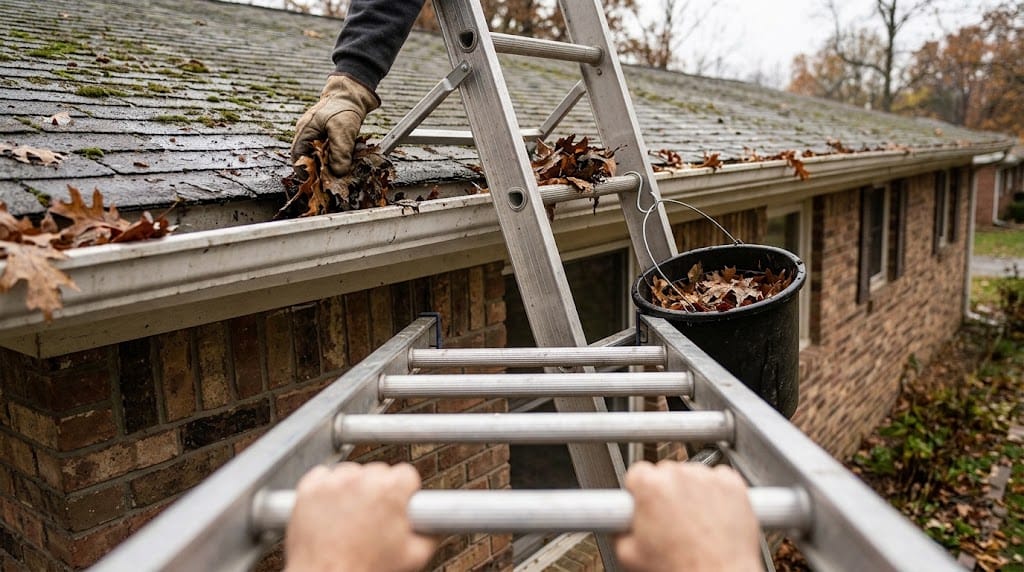
Gutters have one job: move rainwater off the roof and away from your house. When leaves and debris cause a blockage, water spills over the edge and soaks the ground right next to the foundation, stains siding, rots fascia boards, washes out flower beds, and in cold climates can add to ice buildup at the roof edge. Regular gutter cleaning is cheap insurance against water damage and costly repairs, but it is also a ladder job, and ladders are where most of the risk is.
This guide covers when to clean your gutters, how to do it safely yourself, what a professional gutter cleaning service costs, and how to decide whether to hire it out.
Why gutter maintenance matters
A working gutter system, meaning clear gutters and downspouts with the right slope and extensions, is your home's main roof drainage. This Old House links poor drainage from clogged gutters to water pooling around the foundation, which can lead to basement leaks and structural damage. Clogged gutters also get heavy, and This Old House notes the weight of wet debris can make gutters sag or pull away from the fascia, which turns a cleaning job into gutter repairs.
Keeping water moving is the simplest way to protect your home from water damage that starts at the roofline.
When to clean your gutters
This Old House recommends having your gutters cleaned twice per year, and about once a year if you have gutter guards. The most common schedule is:
- Late fall, after most of the leaves have dropped from nearby trees. Cleaning too early means doing it again in a few weeks.
- Late spring, after trees finish dropping seeds, flowers, and pollen tassels.
Bob Vila's cost guide is more conservative: it gives a rule of thumb of at least three cleanings a year, or one at each change of season, and says twice a year may be enough in milder climates. Homes with dense tree cover usually fall on the higher end.
Signs your gutters need cleaning now
This Old House lists these warning signs:
- Water spilling over the sides during rain
- Gutters sagging or pulling away from the fascia
- Plants or weeds growing in the gutters
- Birds, rodents, or insects nesting near the roofline
- Water pooling near the foundation, basement leaks, or new foundation cracks
Also look for dark streaks on siding under the gutters and soil washing out of flower beds below them.
A note on ice dams
Clogged gutters can hold ice in winter, but they are not the root cause of ice dams. ENERGY STAR explains that ice dams form when a warm attic melts snow on the roof and the water refreezes at the colder edge. Keeping the attic cold, through attic ventilation plus air sealing and insulation, is the long-term fix. Our weatherization guide covers that work, and our post on common roof problems covers related damage to look for.
Ladder safety comes first
The CPSC reports that people 65 and older are 80% more likely than other adults to visit an emergency room for injuries involving ladders or stools. Falls from ladders cause injuries ranging from bruises to fractures and can be fatal. Before you climb, follow these rules from the CPSC and OSHA:
- Inspect the ladder before each use. Do not use one with cracked rails, loose rungs, or damaged feet.
- Look up for power lines before you carry or raise the ladder. Do not use a metal ladder near power lines or the service drop to your house.
- Set it on firm, level ground. Never prop the feet on boxes, bricks, or other unstable objects.
- Use the 1-to-4 angle. OSHA says to place the base one quarter of the ladder's working length out from the wall. For a ladder that reaches 16 feet up, that is 4 feet out.
- Extend it at least 3 feet above the roof edge if you will step onto or reach over the roof, per OSHA.
- Keep three points of contact (two hands and a foot, or two feet and a hand) while climbing, and face the ladder.
- Do not stand on the top three rungs of an extension ladder, or the top step of a stepladder unless it was designed for that.
- Have a helper hold the base, as the CPSC recommends, and keep people and pets from walking underneath.
- Move the ladder often. Do not lean or overreach to the side. Climb down and reposition instead.
- Check the load rating. Your weight plus tools and a full bucket must stay under the ladder's maximum.
Do not lean the ladder against the gutter itself if you can avoid it. This Old House suggests a ladder standoff, which rests on the roof instead, steadies the ladder, and prevents dents.
DIY gutter cleaning, step by step
What you need
- Extension ladder rated for your weight plus tools, and a standoff if you have one
- Work gloves (gutter debris can hide sharp screws, broken metal, and wasp nests)
- Safety glasses
- A plastic gutter scoop, or a narrow hand tool that fits inside the gutter
- A bucket with a hook, or a tarp on the ground below
- A garden hose with a spray nozzle
The cleaning process
- Start at the downspout. This Old House advises starting there so standing water has a way out once you clear the opening.
- Scoop debris toward you in small sections and drop it into the bucket or onto the tarp. Wet debris is heavier than it looks, so empty the bucket often.
- Work away from the downspout, moving the ladder every few feet.
- Flush the gutter with the hose, starting at the far end and spraying toward the downspout.
- Check the downspout flow. If water backs up, spray into the downspout from the bottom or top to loosen the clog. A plumber's snake can clear a stubborn one.
- Check the slope. If water sits in one section after flushing, the gutter may have lost its pitch. This Old House gives a standard slope of half an inch for every 10 feet of gutter, sloping toward the downspout.
- Look for damage while you are up there: loose hangers, leaking seams, rust holes, and gaps between the gutter and fascia.
Compost the leaves and twigs if you can. Roofing granules in the debris (they look like coarse sand) are normal in small amounts, but large amounts can mean the shingles are wearing out.
Check where the water goes
Cleaning the gutters does not help if the downspouts dump water against the foundation. This Old House recommends a downspout extension that carries water at least 4 feet away from the foundation, with the ground sloping away from the house.
What professional gutter cleaning costs
This Old House's 2026 cost guide puts the average professional gutter cleaning at about $360, with most jobs between $191 and $529. Height is a major factor:
| Home height | Typical cost |
|---|---|
| One story | $145 to $250 |
| Two stories | $180 to $360 |
| Three stories | $210 to $450 |
Source: This Old House, 2026. Bob Vila's guide notes that heavily clogged gutters can cost 10 to 50 percent more to clean, so staying on schedule helps keep the price down.
When to hire it out
DIY makes sense for a single-story house on level ground if you are comfortable on a ladder and have a helper. This Old House says hiring a professional gutter cleaner is the better choice for multistory homes or if you have mobility concerns, and notes that pros typically flush downspouts and check for drainage problems as part of the job. Hire a gutter cleaning service if any of these apply:
- Your gutters are on the second story or higher.
- The ground under the gutters is sloped, soft, or crowded with landscaping.
- Power lines run near the roof edge.
- You do not have someone to hold the ladder.
- You are 65 or older, or have balance, vision, or mobility concerns.
- The roof is steep, or you would need to walk on it.
- The gutters are sagging, separating, or damaged and need repair as well as cleaning.
Questions to ask a gutter cleaning company
Many local gutter cleaners offer a free estimate. Get two or three, and ask each one the same questions:
- Are you licensed (if your area requires it) and insured for liability and workers' compensation?
- Is downspout flushing included?
- Do you haul the debris away or leave it bagged?
- Will you send before and after photos?
- Will you note any gutter damage, fascia rot, or roof problems, and quote gutter repairs separately?
- Is the quote a fixed price, or will it change based on how clogged the gutters are?
Do gutter guards eliminate cleaning?
They reduce it. Bob Vila's guide puts gutter guard installation at about $6 to $8 per linear foot. In a This Old House survey, nearly 30% of homeowners with gutter guards said they never needed to clean their gutters, compared with 9% of those without guards. This Old House suggests about one cleaning a year with guards. Guards still collect debris on top, and fine material like pine needles and shingle grit can work through some styles. If you install them, plan to inspect them each fall.
For more seasonal jobs to pair with gutter cleaning, see our seasonal home maintenance checklist.
FAQ
How often should gutters be cleaned?
This Old House recommends twice a year, and about once a year with gutter guards. Bob Vila gives a rule of thumb of at least three times a year, or at each change of season. Late fall and late spring are the most useful times.
How much does it cost to have gutters cleaned?
This Old House's 2026 guide puts the national average at about $360, with most jobs between $191 and $529. Two- and three-story homes cost more.
Can I clean gutters from the ground?
Telescoping wand attachments for leaf blowers and hoses can clear light, dry debris from a single-story roofline without a ladder. They are less effective on packed, wet debris, and you cannot see the inside of the gutter to confirm it is clear.
Is it safe to clean gutters on a two-story house myself?
It is a higher-risk job. You need a properly sized extension ladder, firm level ground, a helper, and careful positioning under OSHA's guidance. This Old House recommends hiring a professional for multistory homes.
What happens if I never clean my gutters?
Water overflows and collects near the foundation, which This Old House links to basement leaks and foundation cracks. Clogged gutters can also sag or pull away from the house and attract pests.